LabNews 2025
November 2025
Babl et al., Febs Journal (2025) link to article
SARS-CoV-2 nucleocapsid protein variants have differential RNA chaperone activity

The SARS-CoV-2 nucleocapsid (N) protein facilitates RNA annealing through its RBD–IDR2–CTD region, identifying it as a functional RNA chaperone. The Omicron BA.5 variant shows reduced chaperone activity compared to the Wuhan wild-type protein. Although phosphorylation has no effect on wild-type N, phosphomimetic modification of BA.5 N restores its RNA chaperone function to wild-type levels, indicating a regulatory role of phosphorylation in variant-specific RNA-folding efficiency.
Our work on TV
NANO Episode - 24th April 2025
Our Malaria interview starts after 11min.
Shorter film in the ARD Mediathek.
Our work in the press
Detailed interview in Tagesschau.de

Watzlowik et al., Nature (2025) link to article
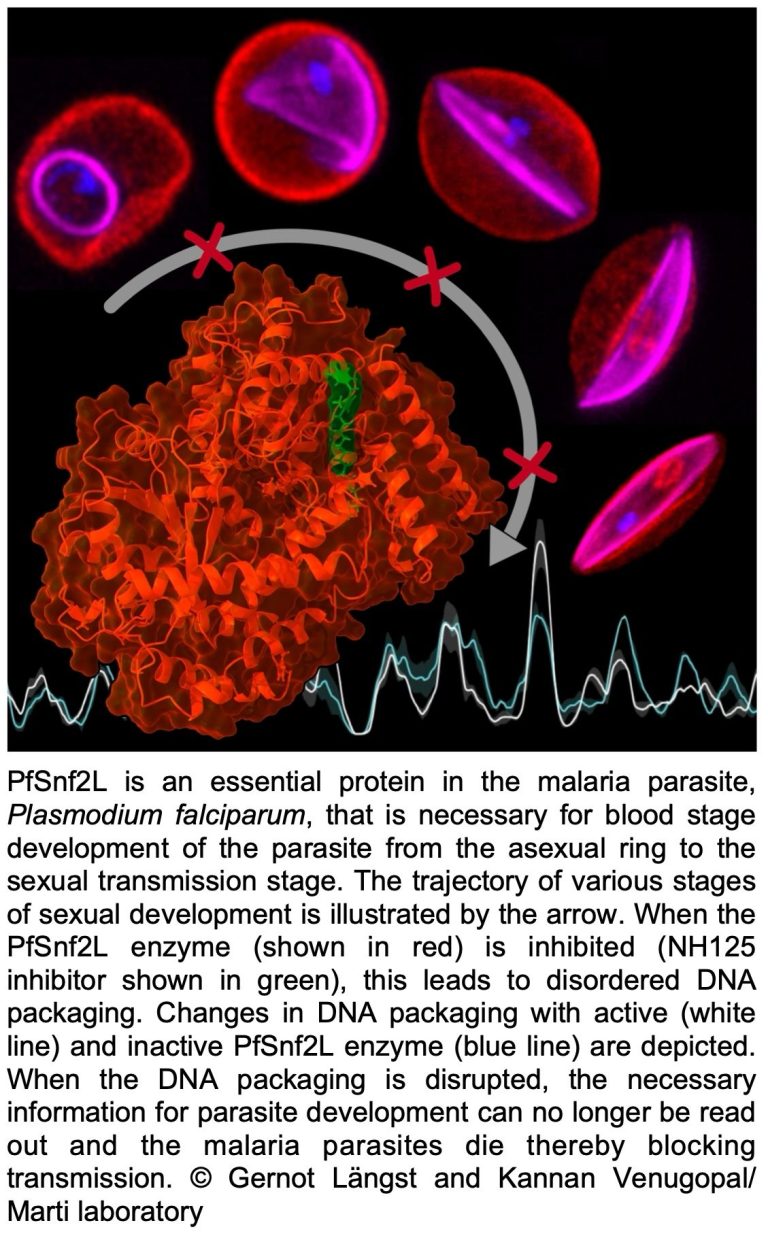
Plasmodium blood stage development requires the chromatin remodeller Snf2L
Malaria is caused by parasites of the genus Plasmodium, which is transmitted to humans through the bite of infected mosquitoes. Plasmodium falciparum, the deadliest of the malaria species, has a highly complex life cycle controlled by precise gene regulation. Understanding these regulatory processes is crucial to specifically combat the pathogen at different stages of development.
Our new study reveals how regulatory proteins modulate genome-wide epigenetic mechanisms to control the precise timing of gene expression in the parasite. We show that the chromatin remodeler PfSnf2L is an essential regulator of “just-in-time” regulation of stage specifically expressed genes. The unique sequence and functional properties of PfSnf2L led to the identification of a highly specific inhibitor that only kills Plasmodium falciparum. A multidisciplinary approach, involving an innovative and unique screening platform for PfSnf2L inhibitors, genetic manipulation of malaria parasites and cutting-edge “OMICs” was used to uncover the role of PfSnf2L. This inhibitor represents a new class of antimalarials, potentially targeting all life cycle stages.
The new findings not only advance basic research but could also offer practical applications. Malaria remains one of the greatest global health threats. In 2022, there were an estimated 247 million infections and over 600,000 deaths, mostly in sub-Saharan Africa. Innovative solutions such as targeting developmental regulation are therefore urgently needed to offer new treatment options.
The study was carried out by an interdisciplinary, multinational team led by Prof. Gernot Längst (University of Regensburg, Germany) and Prof. Markus Meissner (Ludwig-Maximilians University, Munich, Germany) involving researchers from The University of Zürich (Switzerland), The Pennsylvania State University (USA) and the University of Glasgow (UK).
October 2025
March 2025
Baumgartl et al., Embo Reports (2025) link to article
Adenovirus maturation establishes the transcription competent packaging of its genome

This study identifies DNA packaging changes during adenovirus maturation.
Five distinct genomic regions are particularly accessible in mature adenoviruses, facilitating virus disassembly and genome transcription, guiding future vector design.
• In virio DNA accessibility mapped by DMS-seq shows that adenovirus core maturation renders five viral genomic regions accessible.
• The matured genomic structure renders the genome transcription competent after host infection.
• These genomic regions are characterized by low GC-content and periodic dinucleotide patterns.
• The genomic regions are conserved among adenoviruses.